Our Streets, Our Stories
How a group of young men in Glasgow co-created an augmented reality music video — and what it means for trauma-sensitive design, relational empathy, and the future of youth storytelling.
Glasgow has shifted from the “murder capital of Europe” to an international model for violence reduction. Yet young people’s voices remain largely absent from that story. This project hands the microphone — and the camera — back to them.
Our Streets, Our Stories brings together participatory design, augmented reality (AR), and trauma-sensitive methods to explore what young people affected by violence actually experience and imagine. Working with music producer Steg G and a group of young men known as The Wise Men, the project produced a rap and a prototype AR music video that moves beyond representation toward something more relational: a co-created encounter between stories, bodies, spaces, and technologies.
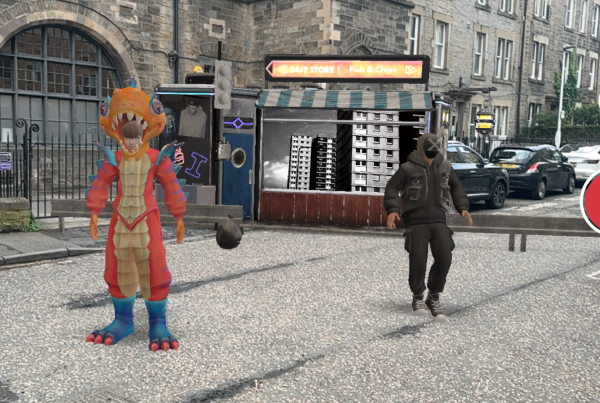
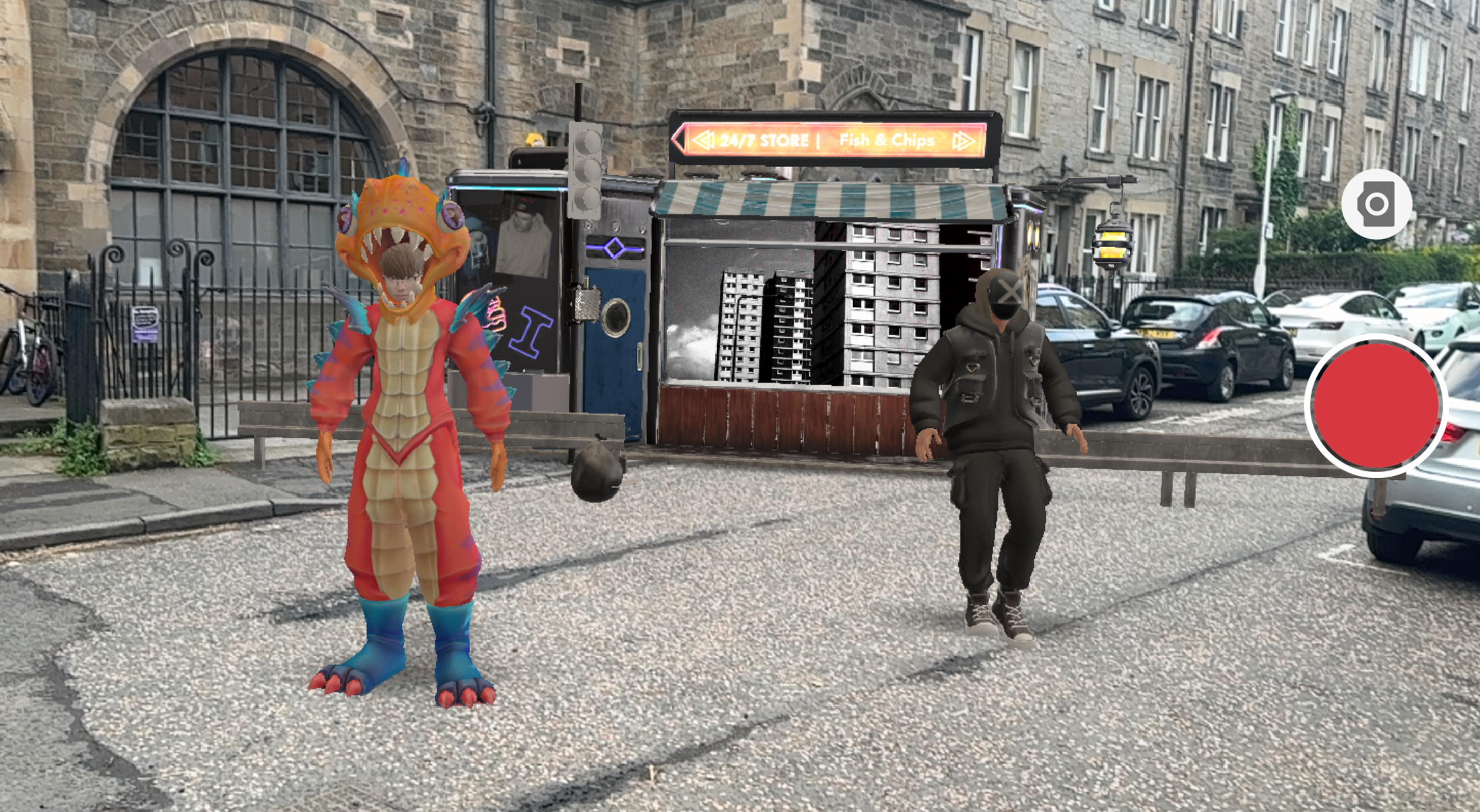
The rap became the audio spine of the project — a trace of the young men’s perspectives expressed through rhythm, tone, and tempo. Lyrics such as “same shit every day,” “trying not to carry a knife,” and “hoping I can change one day” shaped the spatial and temporal arc of the AR experience, which unfolds within a speculative “Neo-Glasgow” cityscape marked by local identity: an Irn-Bru street stall, a Steg G poster.
Rather than appearing directly on screen, The Wise Men collaboratively designed stylised digital personas — speculative vessels offering expressive possibility while maintaining emotional safety and anonymity. The avatars begin projected flat on a virtual screen, echoing the experience of being watched and categorised, then emerge into 3D space around the viewer as the rap unfolds. The transition draws on the visual transformation in A-ha’s Take On Me video: a break from imposed frames, an invitation into a more immersive relational encounter.

AR as relational encounter
The AR scene does not direct the viewer along a prescribed path. Audience members move through and with the performance, encountering avatars from multiple angles, with spatial sound intensity shifting in response to proximity. This openness respects individual pacing and interpretation — consistent with the relational commitments of Stein, Boal, and Barad that underpin the project.
The AR experience operates as an invitation to walk alongside a situated, partial, and relational awareness. The shift from 2D projection to 3D embodiment mirrors the lyrical movement from constraint toward hope, asking audiences to reconsider their emergent capacity for social change.
The AR music video remains at an early stage of public engagement. Its planned installation at Kelvingrove Museum opens new possibilities for understanding how such work is received across diverse public audiences. The wider toolkit, Resources of Hope, will be hosted on the Scottish Centre for Crime and Justice Research (SCCJR) website, situating these stories within ongoing conversations about listening, power, and social transformation.
Supported by the SCCJR Knowledge Exchange and Edinburgh Napier Public Engagement funds.