What if data could make you feel something?
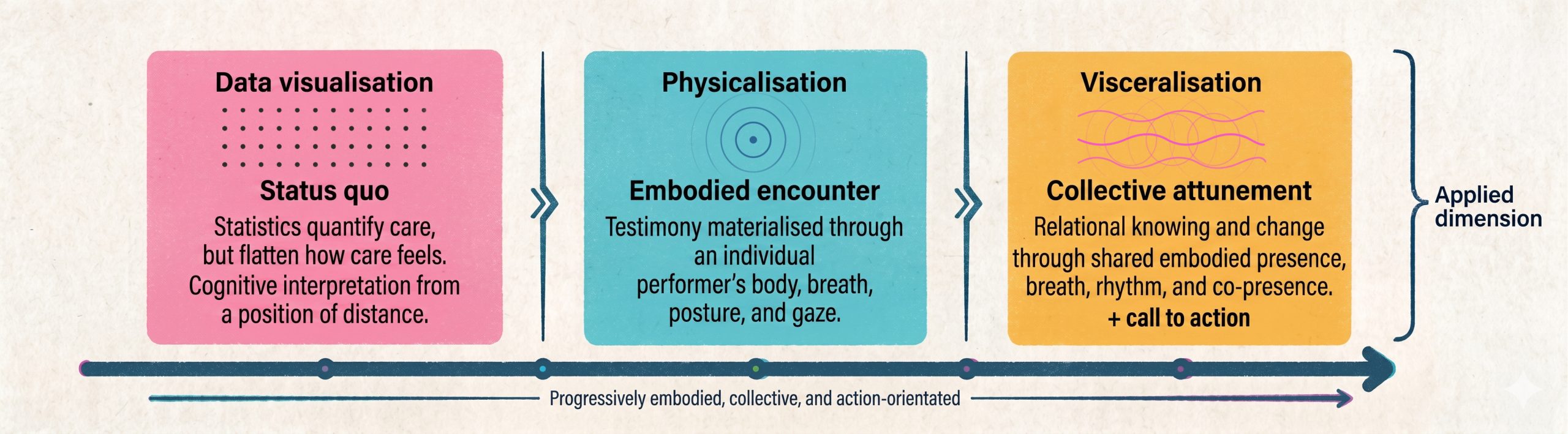
Most of us have seen a chart about a social problem and felt… nothing. The numbers are real. The issue matters. But something fails to connect. This is the gap that the Physicalisation–Visceralisation continuum sets out to close.
The framework describes a journey from cold data to collective feeling. At one end sits familiar data visualisation: bar charts, dashboards, outcome metrics. These are useful. They communicate facts clearly. But they ask your eyes and brain to do the work while your body stays at a polite distance. The framework moves steadily away from that distance, through what it calls physicalisation, where data enters someone’s body through movement, breath, and gesture, and arrives finally at visceralisation, where a whole room of people feel something together.
Here is what that looks like in practice. At a performance held inside the Department for Education in London, a thirteen-year-old girl named Ella stood in front of a minister, senior civil servants, and policymakers. She calmly asked the minister to move seats. Then again. Then again. The room held its breath. Then she explained: that disorientation, that feeling of being moved without warning or reason, is what it feels like to be shifted from placement to placement in the care system. No chart had done that. Her body, and theirs, did.
Later, every person in the room received a pair of headphones and began to hear a recorded testimony from a care-experienced teenager. The artistic director invited them to speak the words aloud as they heard them. Haltingly at first, then together, the room recited: “Not a house, but a home.” They were not watching someone else’s experience. They were, however briefly, inside it.
This is visceralisation: the point where data stops being information and becomes a shared encounter. It does not manufacture false empathy. It creates conditions where people can sense something of another’s lived world, in their own body, alongside others, and feel moved to act. After the performance, the government liaison offered a work placement to one of the young co-researchers on the spot. The minister committed publicly to scaling up this kind of listening.
The framework was developed through research with The Verbatim Formula, an activist theatre group working with care-experienced young people in the UK. Its principles, rooted in trauma-sensitive practice and careful relational design, travel well beyond that context. Any situation where lived experience gets flattened into statistics, and where the gap between policy and feeling needs to be closed, is a situation where visceralisation has something to offer.
Data can make you feel something. It just needs the right conditions.